Analyzing the Role of Vegetation in Urban Heat Islands
This project investigates how vegetation influences temperature in urban heat islands. By comparing areas with varying plant cover, students can assess the cooling effects of vegetation.
Students will use a scratch test to classify common minerals by hardness. This project introduces them to the Mohs hardness scale and helps understand mineral properties through practical observation and testing.

If a mineral can scratch another, then it is harder than the mineral that was scratched.
As an Amazon Associate, this site earns from qualifying purchases.
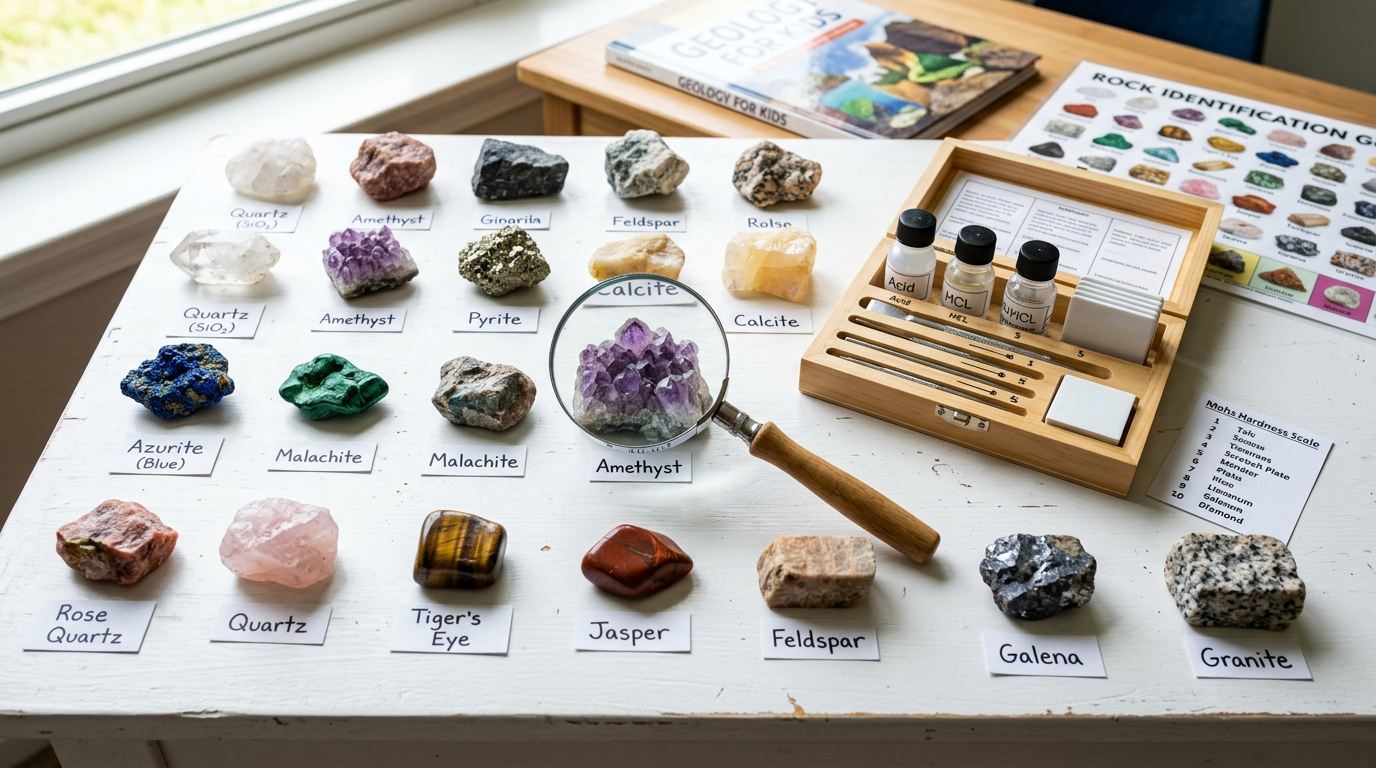
Gather a selection of common mineral samples.
Examine each mineral and note its color, texture, and visual properties.
Use the penny to attempt scratching each mineral. Record observations.
Repeat the scratch test using the nail.
Test with the glass plate and ceramic tile for further classification.
Record which tools scratched which minerals.
Compare results to the Mohs hardness scale.
Organize minerals by hardness according to test results.
The minerals will be classified based on their ability to scratch or be scratched by different objects, aligning with the Mohs hardness scale. This demonstrates how hardness identifies minerals.
Type of mineral
Scratch resistance
Testing tools, Test surface, Environment conditions
Handle minerals with care. Avoid sharp edges, especially when using the nail and glass.
Display a table of minerals and their hardness test results.
Explain the significance of mineral hardness in everyday materials.
Include an interactive element where viewers can try a scratch test.
A scale ranking minerals from softest (1) to hardest (10) based on scratch resistance.
It helps identify minerals and has practical uses in industry and jewelry.
Minor scratches may occur, but minerals are generally tough enough for testing.