Analyzing the Role of Vegetation in Urban Heat Islands
This project investigates how vegetation influences temperature in urban heat islands. By comparing areas with varying plant cover, students can assess the cooling effects of vegetation.
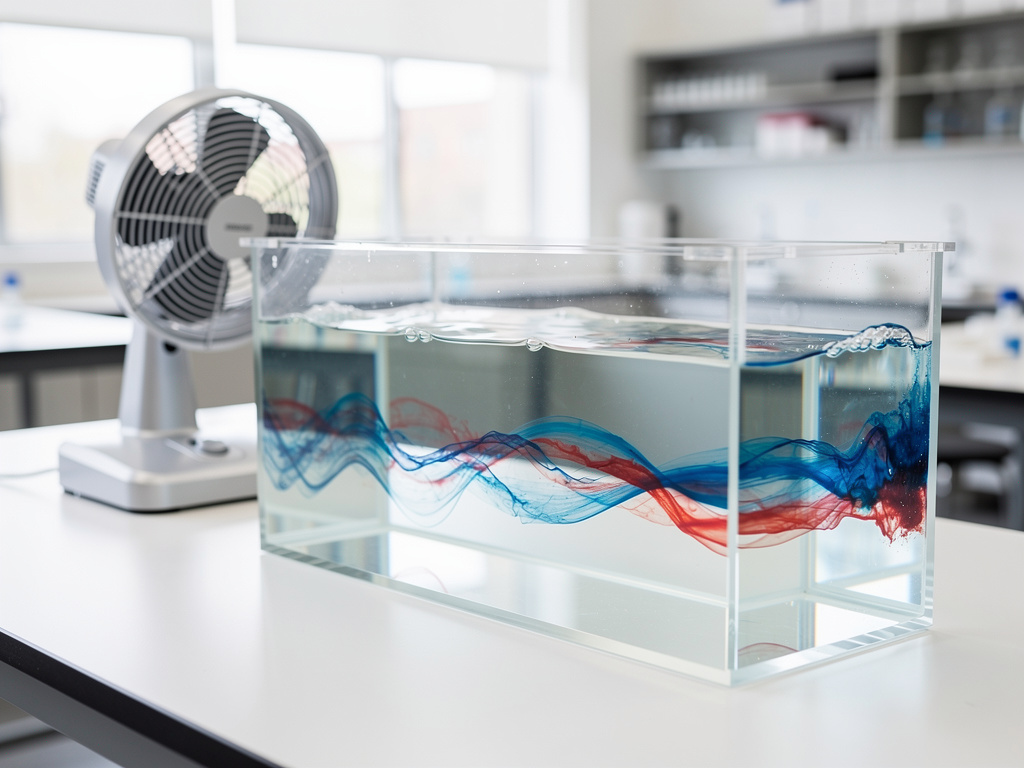
This project involves building a water-tank model to simulate the Pacific trade winds and upwelling. It demonstrates the ENSO cycles of El Nino and La Nina.

If the trade winds weaken, then the El Nino conditions will develop in the model.
As an Amazon Associate, this site earns from qualifying purchases.
Fill the water tank and set up the electric fan to simulate trade winds.
Use the heat lamp to simulate the sun heating the ocean.
Place thermometers in different areas of the tank to monitor temperature changes.
Add food coloring to visualize water movement.
Turn on the fan to simulate normal trade winds and observe upwelling.
Record temperature and water movement for normal conditions.
Reduce fan speed to simulate weakened trade winds (El Nino).
Observe changes in temperature and water movement.
Increase fan speed to simulate stronger trade winds (La Nina).
Record observations for both El Nino and La Nina scenarios.
Analyze data and compare different conditions.
Document the findings with photos and notes.
Weakened trade winds should result in El Nino conditions, with warmer surface waters. Stronger winds should enhance upwelling, typical of La Nina.
Fan speed (trade winds)
Water temperature and movement
Water volume, Heat lamp intensity, Tank size
Handle electrical equipment carefully to avoid water contact.
Create a video of your model in action.
Use diagrams to explain ENSO cycles.
Discuss the global impact of El Nino and La Nina.
El Nino is a climate pattern that describes the unusual warming of surface waters in the eastern Pacific Ocean.
La Nina is characterized by unusually cold ocean temperatures in the Equatorial Pacific, opposite of El Nino.
ENSO cycles significantly impact global weather patterns, affecting agriculture, health, and economies.