Analyzing the Role of Vegetation in Urban Heat Islands
This project investigates how vegetation influences temperature in urban heat islands. By comparing areas with varying plant cover, students can assess the cooling effects of vegetation.
Students will collect rock samples from their local area and perform a series of tests to identify the minerals present. This project helps develop skills in mineralogy and geology.

If rocks are identified using specific tests, then the mineral composition can be accurately categorized based on observable characteristics.
As an Amazon Associate, this site earns from qualifying purchases.
Collect rock samples from your local area.
Observe each rock under the magnifying glass and note its color and texture.
Use the streak plate to determine the color of the rock's streak.
Perform a hardness test on each sample using the test kit.
Drop a small amount of vinegar on the rock to check for carbonate content.
Refer to your guidebook to identify the minerals in each rock sample.
Record all observations and results in your notebook.
Compare your findings with known local geology.
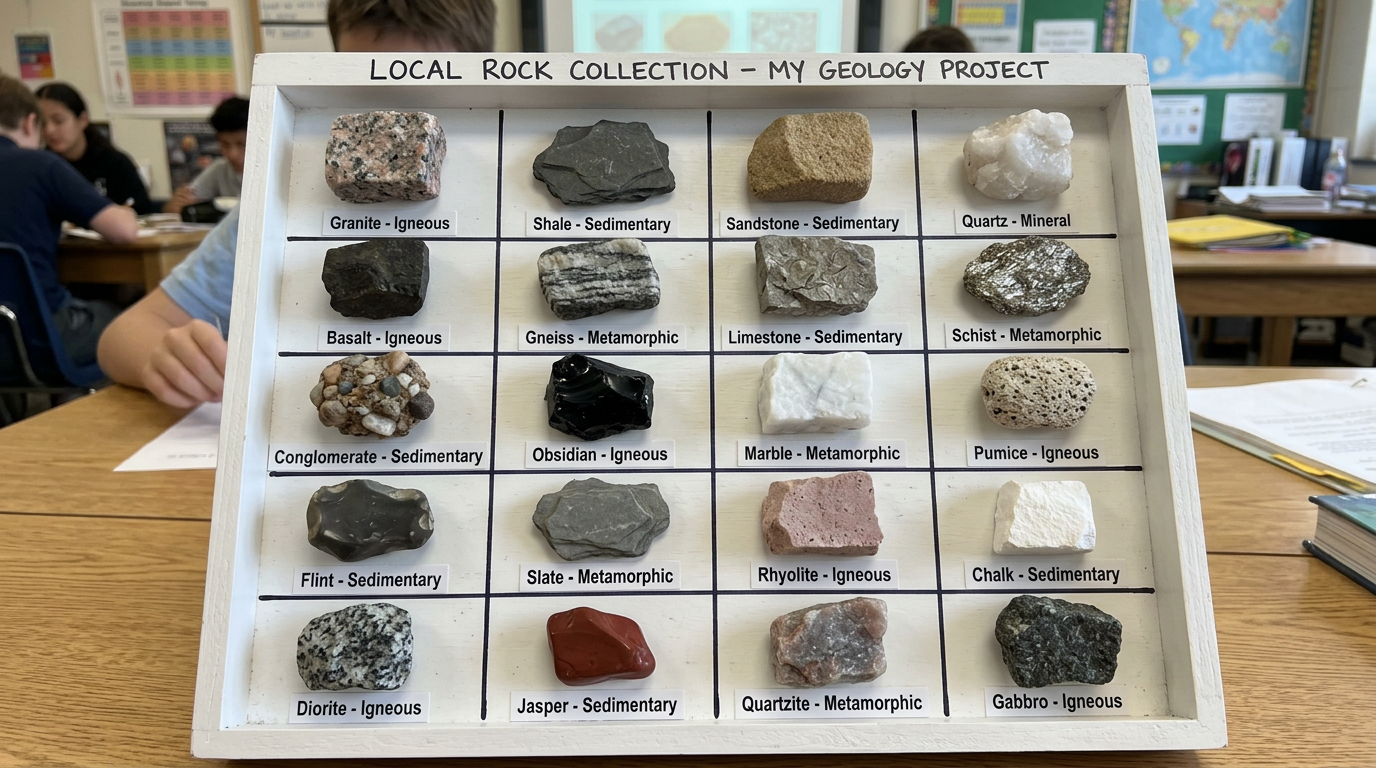
Create a display chart of the rocks and their identified minerals.
Discuss how these minerals are utilized in everyday life.
Each rock type should display unique characteristics that help identify its mineral content. Observed streak, hardness, and reaction to vinegar will aid in accurate identification.
Rock type
Identified minerals
Test methods, Environmental conditions, Observation criteria
Wear safety goggles when using vinegar and handle all samples carefully to avoid injury.
Display rock samples and their corresponding test results.
Use a map to show where each sample was collected.
Explain the industrial uses of identified minerals.
The streak test helps reveal a mineral's true color.
It indicates the presence of carbonate minerals by fizzing.
Yes, many rocks are composed of a variety of minerals.