Analyzing the Role of Vegetation in Urban Heat Islands
This project investigates how vegetation influences temperature in urban heat islands. By comparing areas with varying plant cover, students can assess the cooling effects of vegetation.
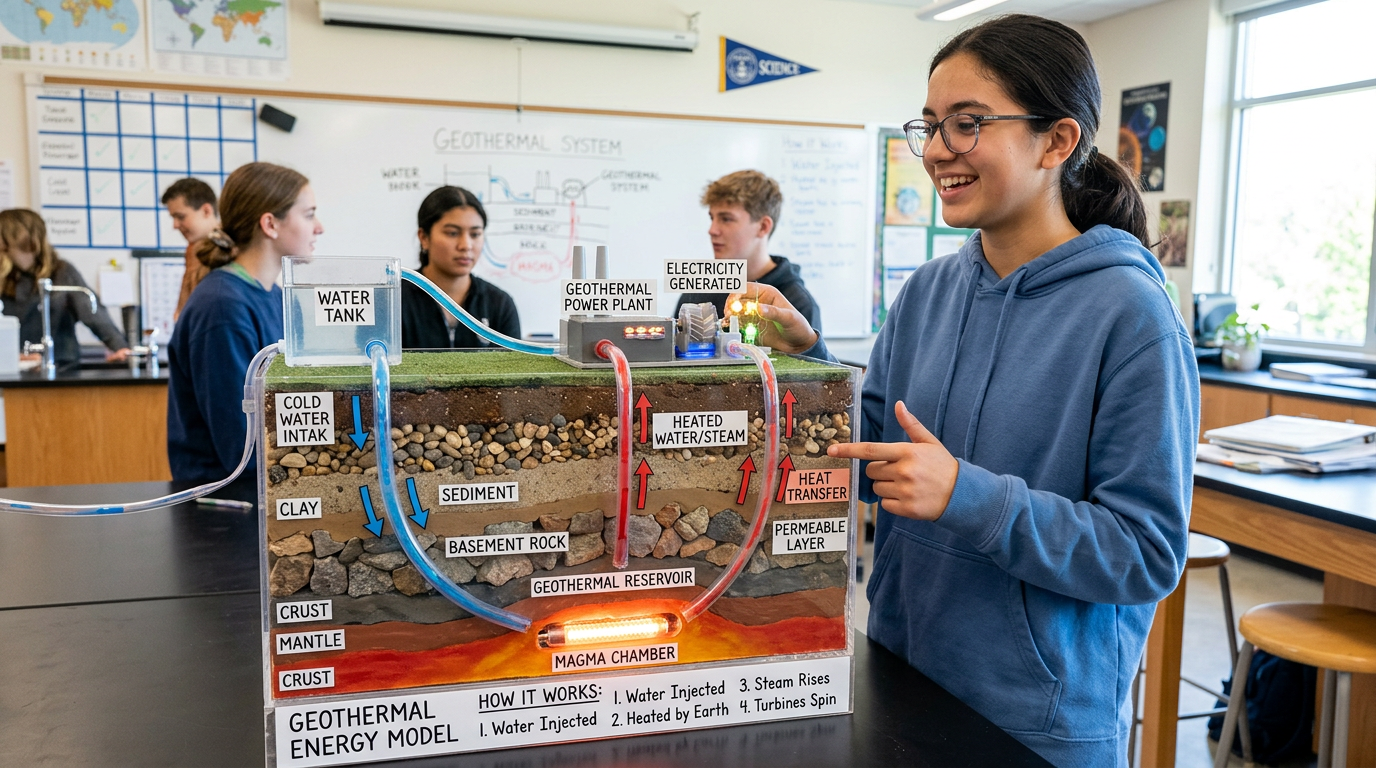
This project involves creating a model to simulate geothermal energy extraction. Students will test various materials and configurations to optimize heat transfer efficiency from a geothermal system.

If a geothermal model uses conductive materials, then it will transfer more heat energy than an insulating setup, optimizing geothermal energy extraction.
As an Amazon Associate, this site earns from qualifying purchases.
Step 1: Construct a model of the Earth's subsurface using modeling clay.
Step 2: Insert copper tubing into the clay to simulate geothermal wells.
Step 3: Connect the tubing to a water pump.
Step 4: Apply thermal grease to optimize heat transfer.
Step 5: Insulate the model with foam to mimic Earth's insulating layers.
Step 6: Position a heat lamp above the model to simulate geothermal heat.
Step 7: Circulate water through the tubing using the pump.
Step 8: Measure temperature changes using a digital thermometer.
Step 9: Experiment with different tubing materials and configurations.
Step 10: Record data on heat transfer efficiency for each setup.
Step 11: Analyze which configuration maximizes energy extraction.
Step 12: Draw conclusions based on data analysis.
It is expected that the model using copper tubing with thermal grease will show higher heat transfer efficiency compared to other configurations, demonstrating effective geothermal energy extraction.
Tubing material
Heat transfer efficiency
Heat source strength, Water flow rate, Model size, Insulation thickness
Handle the heat lamp carefully to avoid burns. Ensure electrical connections are secured properly to prevent short circuits.
Use graphical data representation to compare efficiency across setups.
Include a demonstration video of the working model.
Discuss real-world applications of geothermal energy based on your findings.
Prepare to answer questions about alternative renewable energy sources.
Geothermal energy is heat derived from the Earth's internal processes, which can be used for power generation and heating.
Copper is a good conductor of heat, making it ideal for transferring thermal energy efficiently.
Experimenting with different coolant fluids or tubing geometries could enhance heat transfer efficiency.