Science Fair Projects
physicsmedium middle 3 days

The Unbreakable Egg: An Egg Drop Challenge

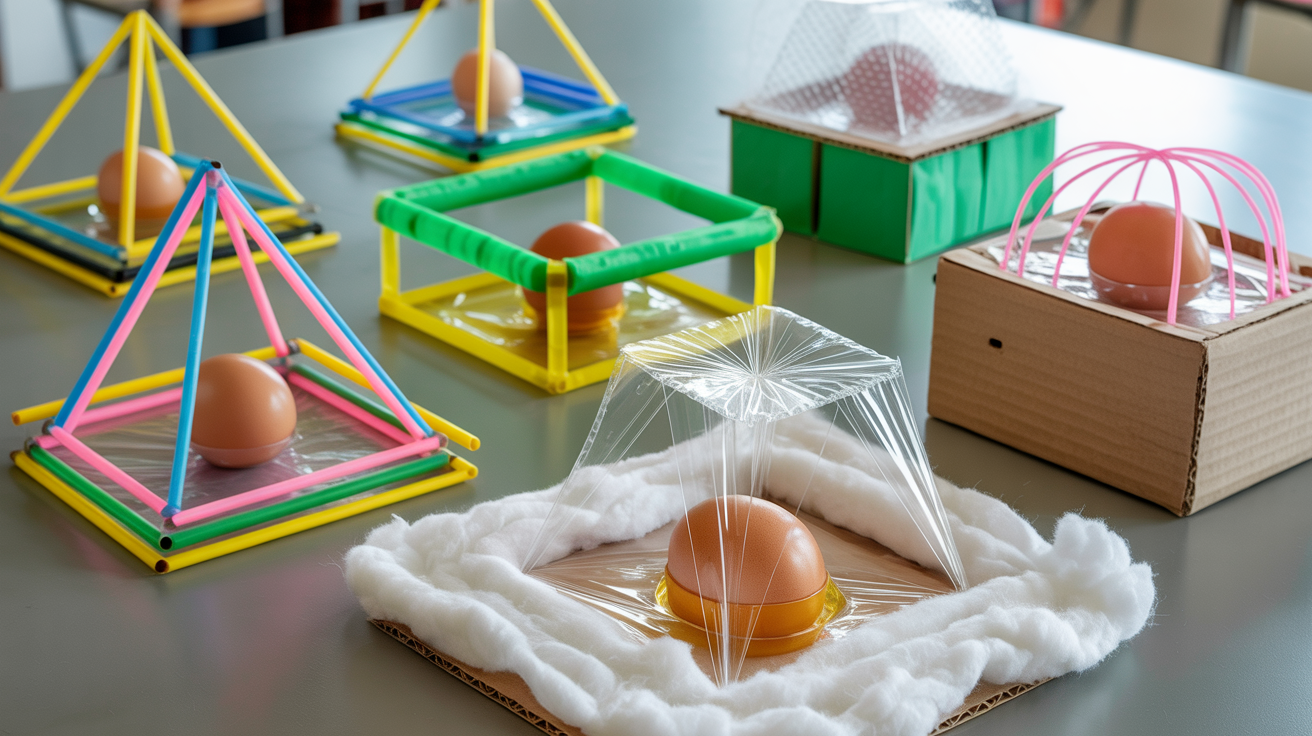
The goal of this project is to design and build a contraption that will prevent a raw egg from breaking when dropped from a significant height. It's a hands-on engineering challenge that teaches important physics principles.

The Unbreakable Egg: An Egg Drop Challenge

Hypothesis

If a container is designed to increase the time of impact and distribute the force of the fall, then it will protect a raw egg from breaking by reducing the overall force exerted on the eggshell.

Materials Needed

Raw eggs — severalBuy
Cardboard box — 1Buy
Recyclable materials (e.g., straws, cotton balls, bubble wrap, packing peanuts, rubber bands) — variousBuy
Tape and glue — as neededBuy
Scissors — 1Buy
Measuring tape — 1Buy

As an Amazon Associate, this site earns from qualifying purchases.

Step-by-Step Procedure

  1. 1

    Brainstorm different designs for your egg drop container. Think about how you can cushion the egg and slow its descent.

  2. 2

    Sketch out your design on paper.

  3. 3

    Build your container using the materials you have gathered. Make sure the egg fits securely inside.

  4. 4

    Find a safe place to drop your container from a height of at least 10 feet (e.g., a second-story window or a ladder).

  5. 5

    Place a raw egg inside your container and drop it.

  6. 6

    Carefully open your container to see if the egg survived the fall.

  7. 7

    If the egg broke, analyze your design and think about how you could improve it.

  8. 8

    Rebuild and retest your design until you have a successful outcome.

  9. 9

    Document each of your designs and the results of each drop test.

Expected Results

A successful design will protect the egg from breaking. This is achieved by using materials that absorb the shock of the impact (cushioning) and by increasing the time it takes for the egg to come to a complete stop. Designs that incorporate parachutes or wings to slow the descent are also often successful.

Variables

Independent Variable

The design of the egg drop container.

Dependent Variable

Whether the egg breaks or not.

Controlled Variables

The height of the drop, the type of egg used, and the surface the container is dropped onto.

Safety Notes

Be extremely careful when dropping the container from a height. Have an adult supervise the drop. Make sure the drop zone is clear of people and objects.

Presentation Tips

  • Display your final, successful container, as well as photos or drawings of your earlier, failed designs.

  • Use diagrams to explain the physics principles of impulse and momentum.

  • If possible, include a slow-motion video of the drop to show how your container works.

Frequently Asked Questions

What is the best material to use for an egg drop project?

There is no single 'best' material. The key is to use a combination of materials that provide cushioning (like cotton balls or bubble wrap) and structural support (like straws or a cardboard frame). The goal is to absorb and distribute the force of the impact.

How does slowing down the impact help protect the egg?

Slowing down the impact increases the time over which the force is applied. According to the impulse-momentum theorem, a longer impact time results in a smaller average force on the egg, making it less likely to break.

What are some common mistakes to avoid in an egg drop project?

Common mistakes include not providing enough cushioning, making the container too heavy, or not securing the egg properly inside the container. It's important to test your design multiple times and make improvements based on the results.

Related Projects

Acoustic Resonance Experiment: Standing Waves in Tubes Science Fair Project
physicsmedium

Acoustic Resonance Experiment: Standing Waves in Tubes Science Fair Project

This experiment allows you to explore sound waves and resonance using tubes. By creating standing waves, you'll visualize how sound behaves in different environments. Perfect for middle school science fairs!

7 days·middle
Analyzing Quantum Tunneling in Semiconductor Devices
physicshard

Analyzing Quantum Tunneling in Semiconductor Devices

This project investigates quantum tunneling phenomena within semiconductor devices. Students will measure how electrons traverse energy barriers and analyze how this impacts device efficiency.

25 days·high
Archimedes' Principle: Testing Buoyancy with Different Objects
physicsmedium

Archimedes' Principle: Testing Buoyancy with Different Objects

This project allows students to test various objects for buoyancy, demonstrating Archimedes' principle. It engages students in hands-on learning about density and displacement.

7 days·middle
Astronomical Observation - Tracking Planetary Motion
physicsmedium

Astronomical Observation - Tracking Planetary Motion

In this project, you will observe and record the positions of planets in the night sky over a month. By using a telescope or binoculars, you will track their movements, document their position on specific dates, and analyze their orbits to understand celestial mechanics. This project fosters an appreciation of astronomy and the dynamics of our solar system.

14 days·high
Atmospheric Pressure and Weather Patterns Analysis
physicsmedium

Atmospheric Pressure and Weather Patterns Analysis

This project investigates how changes in atmospheric pressure correlate with weather conditions. By using a barometer to measure pressure and recording local weather patterns over a week, you will analyze the data to determine relationships and predict weather changes. This project emphasizes the importance of atmospheric science in understanding our climate.

7 days·middle
Balloon Rocket Experiment: Explore Newton's Third Law in Action
physicseasy

Balloon Rocket Experiment: Explore Newton's Third Law in Action

This exciting balloon rocket experiment demonstrates Newton's third law of motion. By launching balloons, students can visually see how every action creates an equal and opposite reaction!

1 days·middle

Like this project? Get more ideas!