Science Fair Projects
physicsmedium middle 2 days

Building a Solar Oven to Cook S'mores

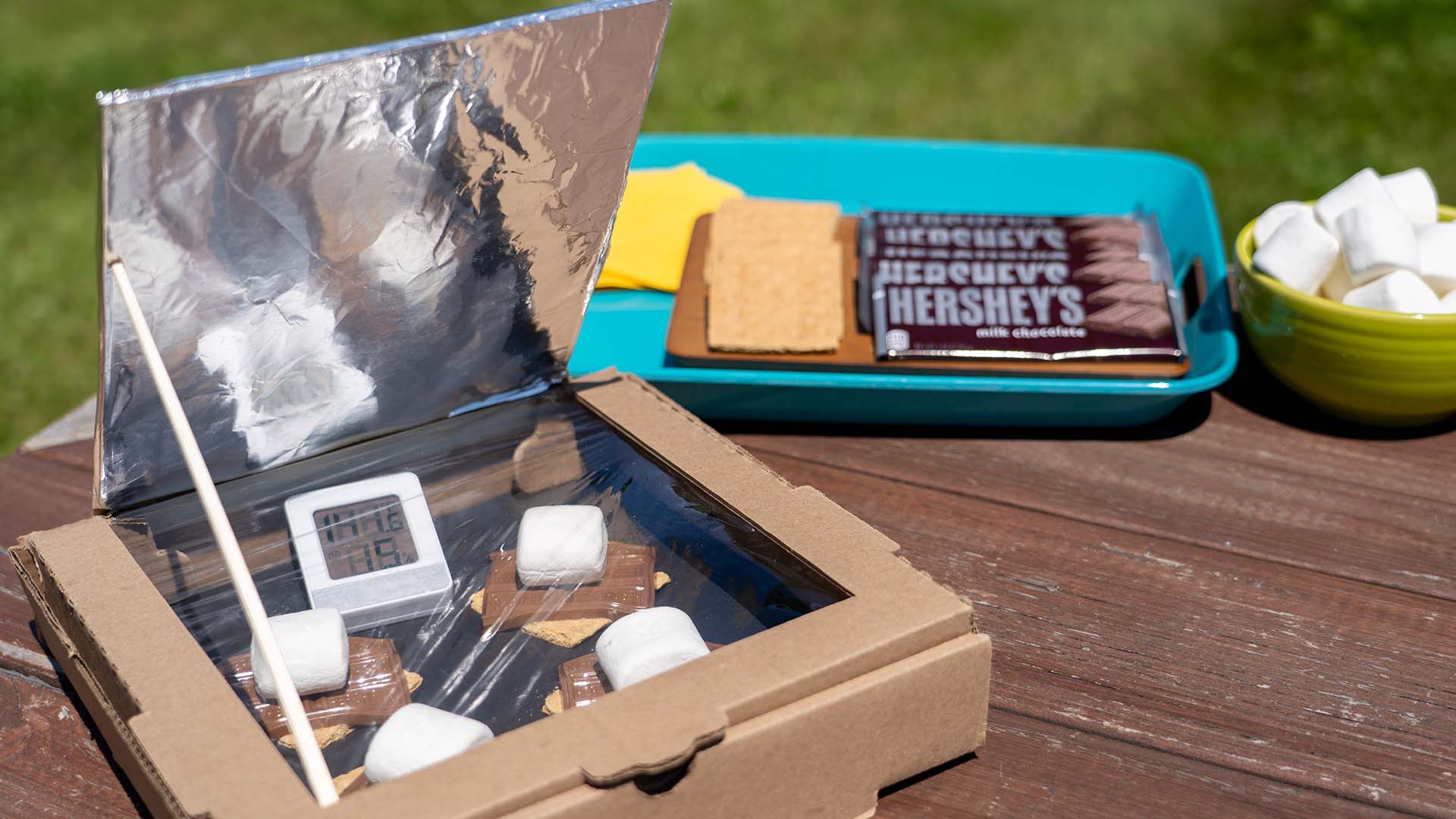
In this project, you will design and build a functional solar oven using a cardboard box, aluminum foil, and plastic wrap. You will then test your oven by using it to melt chocolate and marshmallows for s'mores, demonstrating the conversion of light energy to heat energy.

Building a Solar Oven to Cook S'mores

Hypothesis

If a cardboard box is lined with aluminum foil to reflect sunlight and covered with plastic wrap to trap heat, then it will function as a solar oven, reaching a high enough temperature to melt chocolate and cook a s'more.

Materials Needed

Cardboard pizza box — 1Buy
Aluminum foil — 1 rollBuy
Clear plastic wrap — 1 rollBuy
Black construction paper — 1 sheetBuy
Tape and glue — as neededBuy
Box cutter or scissors — 1Buy
Ruler and marker — 1Buy
Wooden skewer or stick — 1Buy
S'mores ingredients (graham crackers, marshmallows, chocolate) — enough for oneBuy

As an Amazon Associate, this site earns from qualifying purchases.

Step-by-Step Procedure

  1. 1

    On the lid of the pizza box, draw a square one inch from the edges.

  2. 2

    With adult help, use a box cutter to cut along three sides of the square, leaving one side attached to create a flap.

  3. 3

    Line the inside of the flap with aluminum foil, shiny side out. This is your reflector.

  4. 4

    Open the box and line the bottom with aluminum foil, then place the black construction paper on top of the foil.

  5. 5

    Create a double layer of plastic wrap over the opening you cut in the lid, taping it securely to create an airtight window.

  6. 6

    Take your oven outside on a sunny day. Prop the reflector flap open with the wooden skewer to direct sunlight into the box.

  7. 7

    Place a s'more (graham cracker, chocolate, marshmallow) on the black paper inside the oven.

  8. 8

    Close the lid and position the oven so it faces the sun.

  9. 9

    Wait for 30-60 minutes, checking periodically, until your s'more is melted and gooey.

  10. 10

    You can use a thermometer to measure the temperature inside your oven.

Expected Results

On a sunny day, the solar oven should be able to reach temperatures well over 150°F (65°C), which is hot enough to melt chocolate and soften a marshmallow. The aluminum foil reflects sunlight into the box, the black paper absorbs the light energy and converts it to heat, and the plastic wrap traps the heat inside, just like a greenhouse.

Variables

Independent Variable

The design of the solar oven and the amount of direct sunlight.

Dependent Variable

The temperature reached inside the oven and its ability to cook the s'more.

Controlled Variables

The ingredients of the s'more and the location of the oven.

Safety Notes

An adult should do all the cutting with the box cutter. The inside of the oven can get hot, so be careful when removing your s'more. Never leave a solar oven unattended.

Presentation Tips

  • Display your solar oven and explain how each part (reflector, black paper, plastic wrap) works.

  • If possible, make a s'more for the judges during your presentation (this may require a very sunny day or a heat lamp).

  • Discuss the potential of solar energy as a clean and renewable power source.

Frequently Asked Questions

Why is the bottom of the oven lined with black paper?

Dark, matte surfaces are excellent absorbers of light. The black paper absorbs the sunlight that is reflected into the box and converts the light energy into heat energy, which then cooks the food.

How does the plastic wrap help cook the food?

The plastic wrap acts like the glass of a greenhouse. It allows sunlight (shortwave radiation) to pass through into the box, but it prevents the heat (longwave radiation) from escaping. This is called the greenhouse effect, and it traps the heat inside the oven.

How can I make my solar oven hotter?

To make your oven hotter, you can try using a larger reflector flap, insulating the walls of the box (e.g., with crumpled newspaper), or using a more insulated box (like a styrofoam cooler). Making sure the oven is well-sealed to prevent heat from escaping is also very important.

Related Projects

Acoustic Resonance Experiment: Standing Waves in Tubes Science Fair Project
physicsmedium

Acoustic Resonance Experiment: Standing Waves in Tubes Science Fair Project

This experiment allows you to explore sound waves and resonance using tubes. By creating standing waves, you'll visualize how sound behaves in different environments. Perfect for middle school science fairs!

7 days·middle
Analyzing Quantum Tunneling in Semiconductor Devices
physicshard

Analyzing Quantum Tunneling in Semiconductor Devices

This project investigates quantum tunneling phenomena within semiconductor devices. Students will measure how electrons traverse energy barriers and analyze how this impacts device efficiency.

25 days·high
Archimedes' Principle: Testing Buoyancy with Different Objects
physicsmedium

Archimedes' Principle: Testing Buoyancy with Different Objects

This project allows students to test various objects for buoyancy, demonstrating Archimedes' principle. It engages students in hands-on learning about density and displacement.

7 days·middle
Astronomical Observation - Tracking Planetary Motion
physicsmedium

Astronomical Observation - Tracking Planetary Motion

In this project, you will observe and record the positions of planets in the night sky over a month. By using a telescope or binoculars, you will track their movements, document their position on specific dates, and analyze their orbits to understand celestial mechanics. This project fosters an appreciation of astronomy and the dynamics of our solar system.

14 days·high
Atmospheric Pressure and Weather Patterns Analysis
physicsmedium

Atmospheric Pressure and Weather Patterns Analysis

This project investigates how changes in atmospheric pressure correlate with weather conditions. By using a barometer to measure pressure and recording local weather patterns over a week, you will analyze the data to determine relationships and predict weather changes. This project emphasizes the importance of atmospheric science in understanding our climate.

7 days·middle
Balloon Rocket Experiment: Explore Newton's Third Law in Action
physicseasy

Balloon Rocket Experiment: Explore Newton's Third Law in Action

This exciting balloon rocket experiment demonstrates Newton's third law of motion. By launching balloons, students can visually see how every action creates an equal and opposite reaction!

1 days·middle

Like this project? Get more ideas!